CFO
Owns the report to the board and wants the modeling and the write-up handled without adding headcount.
NineFive produces your quarterly interest rate risk report: rate shocks and scenarios run against your balance sheet, with the effect on net interest income, economic value of equity, liquidity, and capital, packaged for ALCO, the board, and your examiners. Your team sets the risk limits and signs off; NineFive does the modeling and the write-up.
Every quarter
Delivered ahead of your ALCO meeting after call report data posts
NII and EVE
Parallel shocks, non-parallel shifts, and liquidity
Examiner-ready format
Documented assumptions and assumption review
Each quarter NineFive models your balance sheet, runs the scenarios your policy calls for, and delivers a report your ALCO and board can read and your examiners recognize.
Plus and minus 100 to 400 basis point parallel shocks, plus curve steepeners and flatteners, run against your assets, liabilities, and off-balance-sheet positions.
The earnings effect of each scenario over a one and two year horizon, and the effect on the economic value of equity, so the board sees both the near-term and the long-term risk.
Deposit betas, decay rates, prepayment speeds, and non-maturity deposit assumptions, set with your team, documented, and reviewed each quarter against what actually happened.
How the risk position moved since last quarter and why, next to where peer banks sit, so a change is explained before anyone asks.
Owns the report to the board and wants the modeling and the write-up handled without adding headcount.
Sets the assumptions with NineFive and keeps ownership of the risk position and the limits.
Reviews a clear report every quarter instead of a spreadsheet only one person understands.
Reads the near-term and long-term risk with peer context, in plain terms.
After each quarter's call report data posts, NineFive updates the model in BankCore, runs the scenarios your policy requires, and reviews assumptions against what happened. You get a draft to review, then the final report and an ALCO presentation.
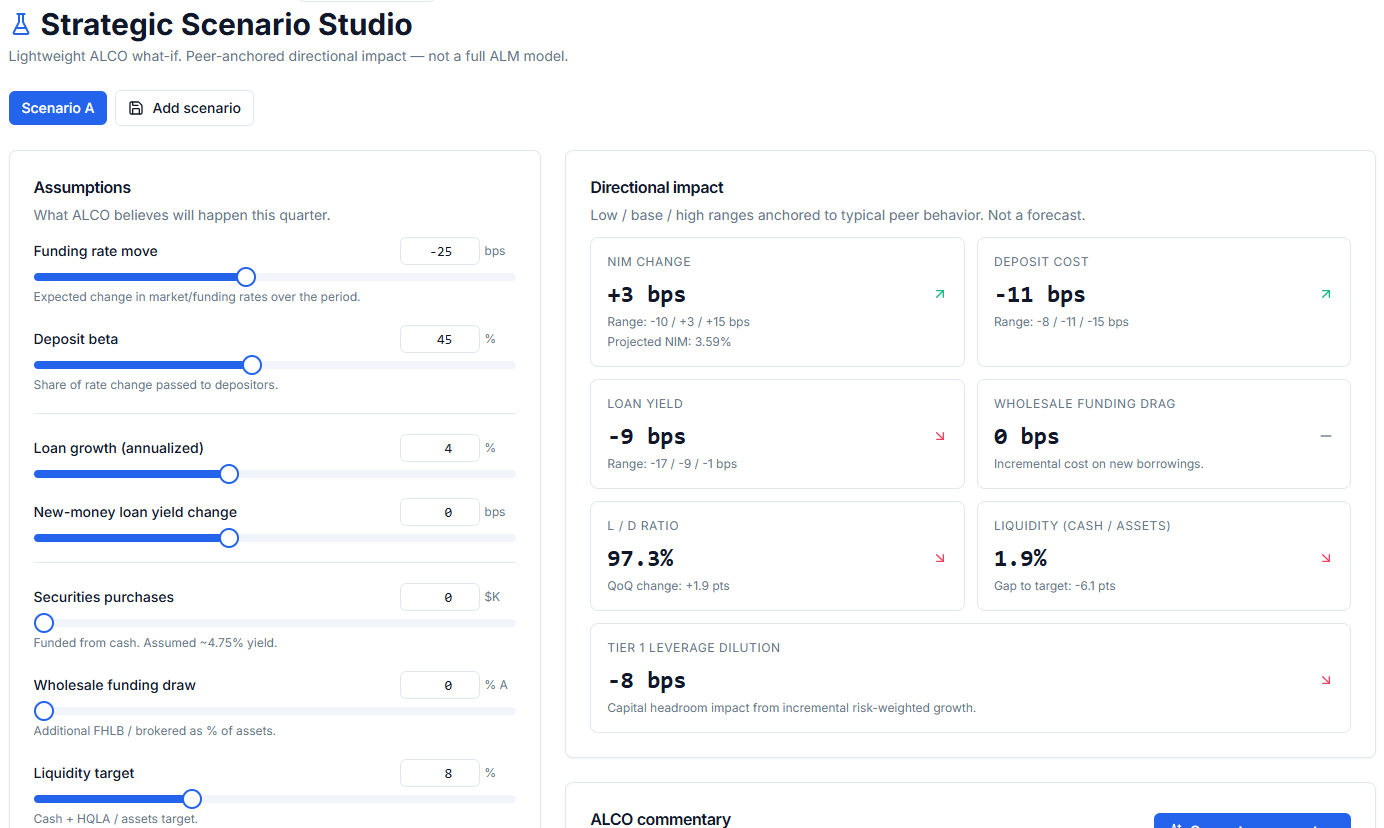
An interest rate risk report shows how a bank's earnings and value would change if rates moved. NineFive's quarterly report covers parallel rate shocks of plus or minus 100 to 400 basis points and non-parallel curve shifts, with the effect on net interest income over one and two years, economic value of equity, liquidity, and capital, plus documented assumptions and a quarter-over-quarter trend.
Net interest income, or NII, measures the earnings effect of a rate move over a one to two year horizon. Economic value of equity, or EVE, measures the effect on the present value of the balance sheet, a longer-term view. Examiners expect a community bank to look at both, and the report includes both.
NineFive prepares the report in the format examiners expect, with documented assumptions and assumption review, and supports the bank through the exam. The bank still owns its risk management, sets its own risk limits, and is responsible for its risk position; the report is one input to that.
Deposit beta is the share of a rate move a bank passes through to deposit rates, and it is one of the largest drivers of the results. NineFive sets deposit beta and decay assumptions with your team and anchors the ranges to how peer banks have actually repriced deposits, drawn from call report data in BankCore.
Independent model validation is a separate function that should stay independent of whoever produces the report. It is not bundled with the quarterly IRR report.
Send a recent call report and we will show you what the report looks like on your balance sheet.